Data Entry

This Data Entry portfolio showcases my ability to accurately enter, organize, and manage information with strong attention to detail. I am comfortable using Microsoft Excel, Word, Google Sheets, Google Docs, and Google Drive for data processing, document organization, and file management. I focus on maintaining accuracy, keeping information organized, and completing tasks efficiently while meeting deadlines and providing reliable support to clients.
SAMPLE WORK #1: CUSTOMER INFORMATION DATA BASE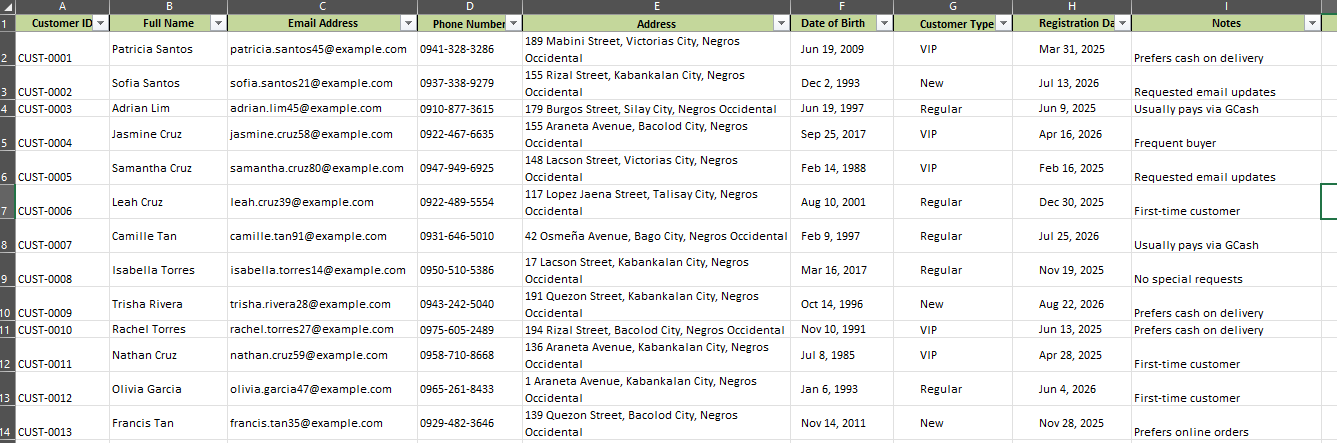
This Customer Information Database is a structured record used to systematically track and manage customer details, supporting essential business responsibilities such as maintaining accurate customer profiles, verifying contact information, and organizing customer records. Encoded and organized using Microsoft Excel, it demonstrates how accurate data entry and record-keeping contribute to efficient business operations, allowing information to be easily accessed, filtered, and updated while maintaining data accuracy and confidentiality.
SAMPLE WORK #2: PRODUCT CATALOG DATA ENTRY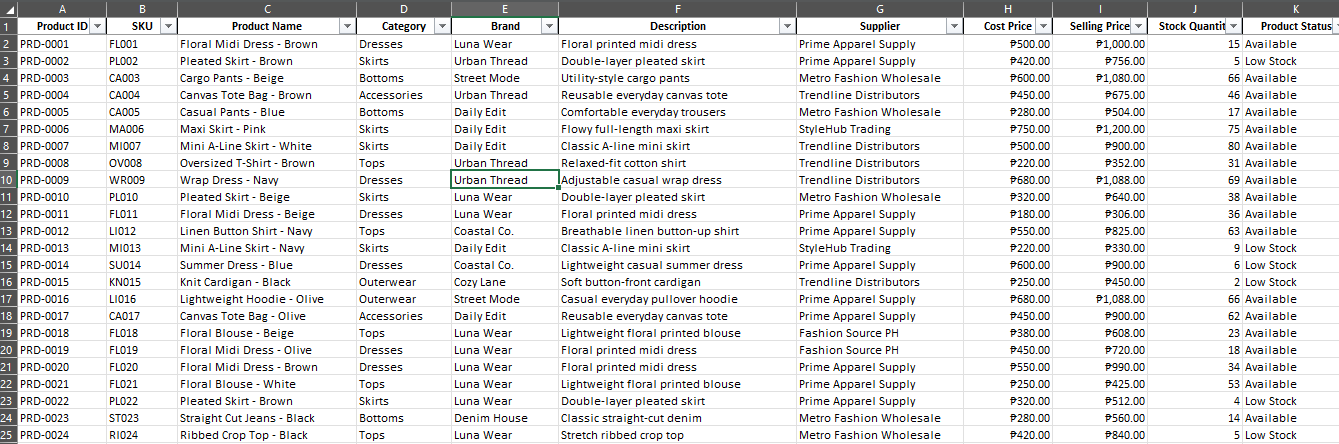
The Product Catalog is an organized Excel record used to manage product and inventory information for an online clothing store. It includes Product ID and SKU for product identification, product name, category, brand, and description for product details, supplier information, cost and selling prices, stock quantity, and product status. This work sample demonstrates my accuracy, attention to detail, data organization, consistency, and proficiency in Microsoft Excel for efficient product and inventory management.
SAMPLE WORK #3: PDF-TO-EXCEL DATA ENTRY & TRANSCRIPTION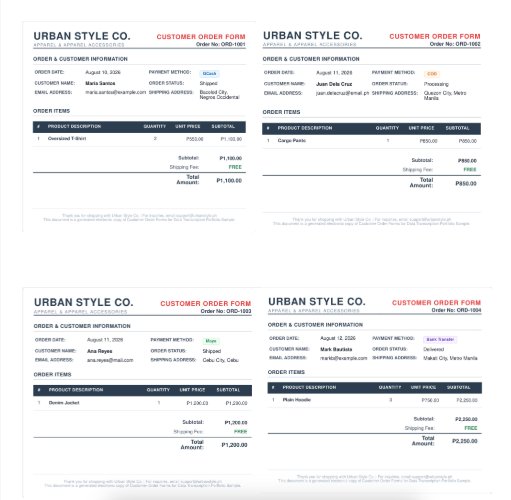

This work sample demonstrates the accurate transcription and structured conversion of customer order forms from PDF format into a centralized Microsoft Excel spreadsheet, utilizing 4 sample customer order documents. The spreadsheet captures complete order records—including order numbers, customer names, contact emails, products, quantities, unit prices, total amounts, payment methods, order statuses, and shipping details. It highlights how accurate data entry, structured file-to-spreadsheet conversion, and organized record-keeping enable businesses to monitor sales, track order fulfillment, and maintain reliable transaction records while ensuring total consistency and attention to detail.
SAMPLE WORK #4: DATA CLEANING & FORMATTING – CUSTOMER RECORD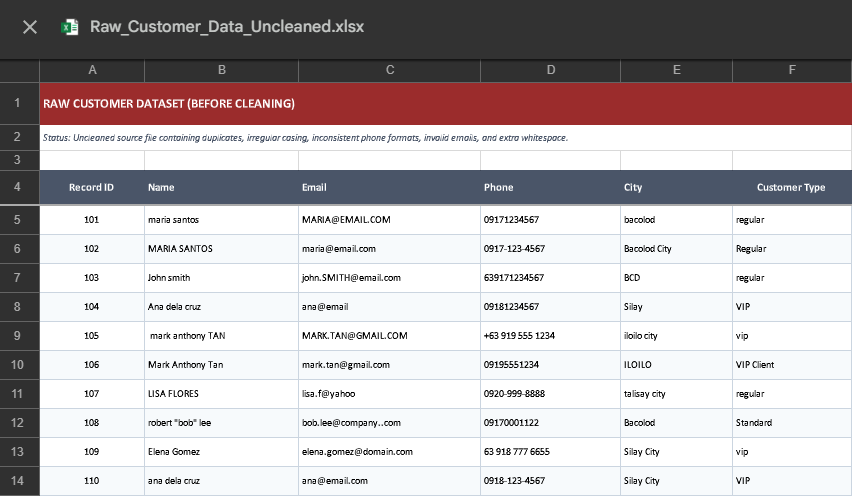
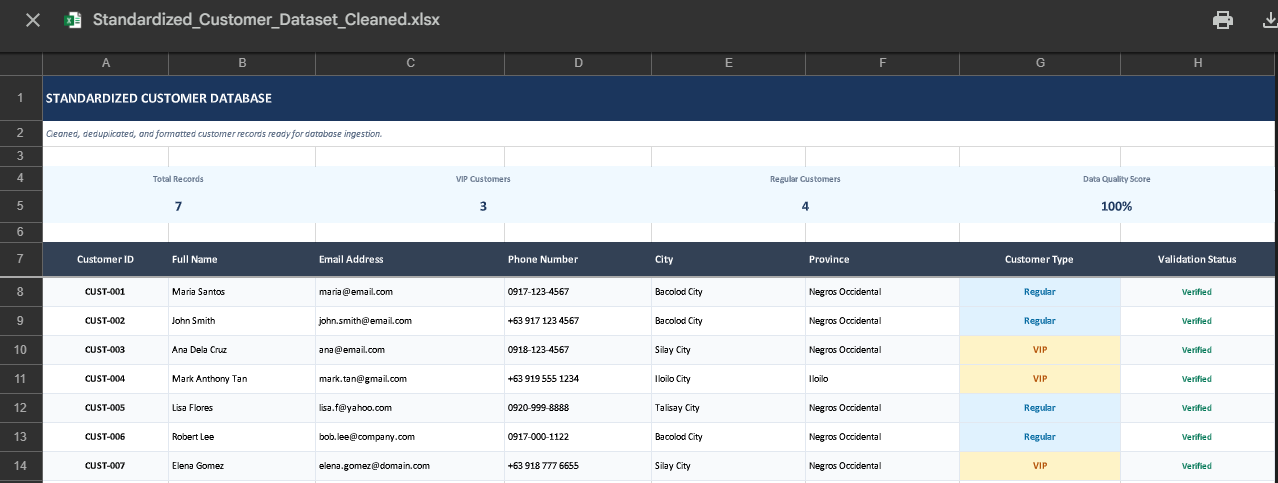
This work sample demonstrates the end-to-end cleaning, deduplication, and standardization of an unorganized customer database into an audit-ready, CRM-compatible spreadsheet. Working with raw, chaotic client data—containing duplicate records, mixed capitalization, inconsistent phone formatting, non-standard city abbreviations, and corrupted email syntax—the dataset was systematically scrubbed, validated, and corrected. It highlights advanced data hygiene practices, attention to detail, and error-checking capabilities essential for maintaining accurate, reliable business records.
SAMPLE WORK #5: INVOICE DATA ENTRY
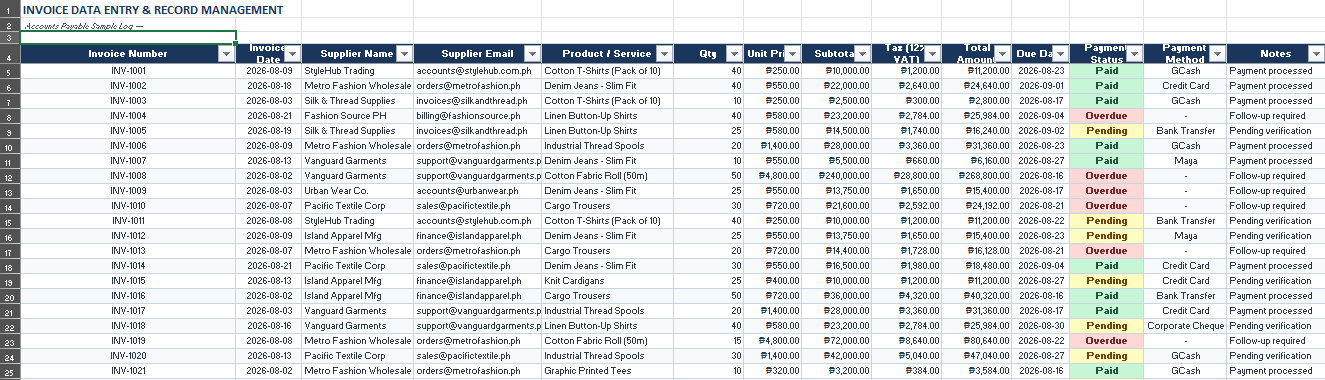
This work sample demonstrates the accurate encoding, organization, and tracking of supplier invoices within a structured Microsoft Excel workbook, modeled on a dataset of 25 supplier records. The spreadsheet captures complete transaction details—including invoice numbers, invoice dates, supplier names, contact emails, product/service descriptions, quantities, unit prices, subtotals, tax calculations, total amounts, due dates, payment statuses, payment methods, and reference notes. It highlights how systematic data transcription, automated financial calculations, and organized record-keeping enable small businesses to monitor outstanding accounts payable, track payment deadlines, and maintain error-free financial histories.
SAMPLE WORK #6: ORDER DATA ENTRY
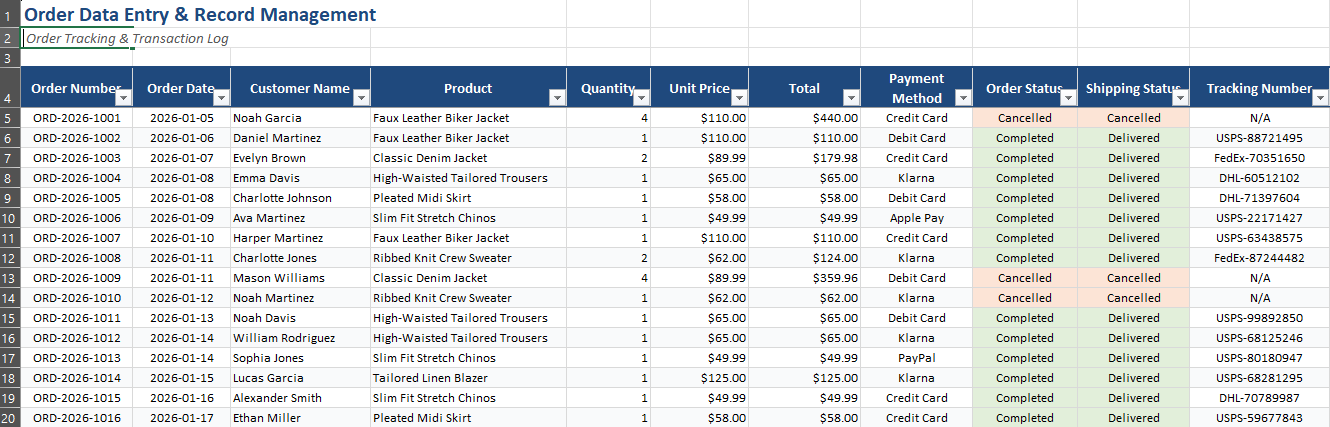
This work sample demonstrates the accurate encoding, organization, and lifecycle tracking of customer order records for an e-commerce clothing business, modeled on a dataset of 20 fictional orders. The spreadsheet captures essential order details—including unique order numbers, order dates, customer names, product descriptions, quantities, unit prices, calculated order totals, payment methods, order fulfillment statuses, shipping progress, and shipment tracking numbers. It highlights how methodical data entry, basic formula automation, and structured record-keeping help online retailers seamlessly monitor purchases, manage order fulfillment, and maintain error-free transaction histories.